

























































Notification

THANK YOU FOR MAKING AN APPOINTMENT AT AIH.
Would you like to pre-register?
Please fill in the information below
Urgent
REFLUX TREATMENT NOT WORKING? DON'T OVERLOOK ESOPHAGEAL HYPERSENSITIVITY

Overview
You have been taking medication to treat acid reflux for weeks, even months. You avoid coffee, alcohol, and spicy or sour foods, refrain from eating late at night, and strictly follow your doctor's instructions. Yet, the burning sensation behind your breastbone, heartburn, or chest discomfort still occurs, sometimes even causing insomnia and affecting your work and daily life.
Many people assume this means the reflux is worsening or the medication is not strong enough, so they arbitrarily increase the dosage, switch medications, or prolong use. However, the reality is not always like that.
Dr. Mai Vien Phuong, Master’s Degree, Head of the Gastrointestinal Endoscopy Unit at the American International Hospital (AIH), stated that in his years of clinical practice, he has encountered quite a few patients who followed the correct treatment regimen yet still experienced prolonged symptoms. After examinations and necessary tests, the cause was found not to be excessive gastric acid, but rather that the esophagus had become overly sensitive. Only a very small amount of reflux fluid, or even normal stimuli that are completely harmless in healthy individuals, is enough to cause a burning sensation or pain.
This condition is known as esophageal hypersensitivity. This is an increasingly recognized pathology in the specialty of gastroenterology because its clinical presentation closely resembles gastroesophageal reflux disease, yet its pathogenesis and treatment directions differ. If not correctly diagnosed, patients may use acid-suppressing medications for a long period without achieving the expected efficacy.
In this article, Dr. Mai Vien Phuong will explain what esophageal hypersensitivity is, how to differentiate it from gastroesophageal reflux disease, and why accurate diagnosis of the underlying cause plays a crucial role in treatment.
The same symptom does not necessarily mean the same disease
Many people experiencing a burning sensation behind the breastbone, sour regurgitation, or chest discomfort immediately think of gastroesophageal reflux disease. In reality, while this is indeed the most common cause, not everyone with these symptoms is suffering from reflux.
Some individuals undergo an endoscopy that reveals acid-induced esophagitis. However, others have a completely normal endoscopic appearance, yet find no relief after taking acid-suppressing medications for many months. This leaves many people wondering: “If there is no longer any inflammation, why do I still experience a burning sensation?”
The answer is that the burning sensation behind the breastbone can stem from various distinct mechanisms. Therefore, accurately identifying the root cause is crucial for selecting the appropriate treatment approach.
Gastroesophageal Reflux Disease
This is a medical condition that almost everyone has heard of.
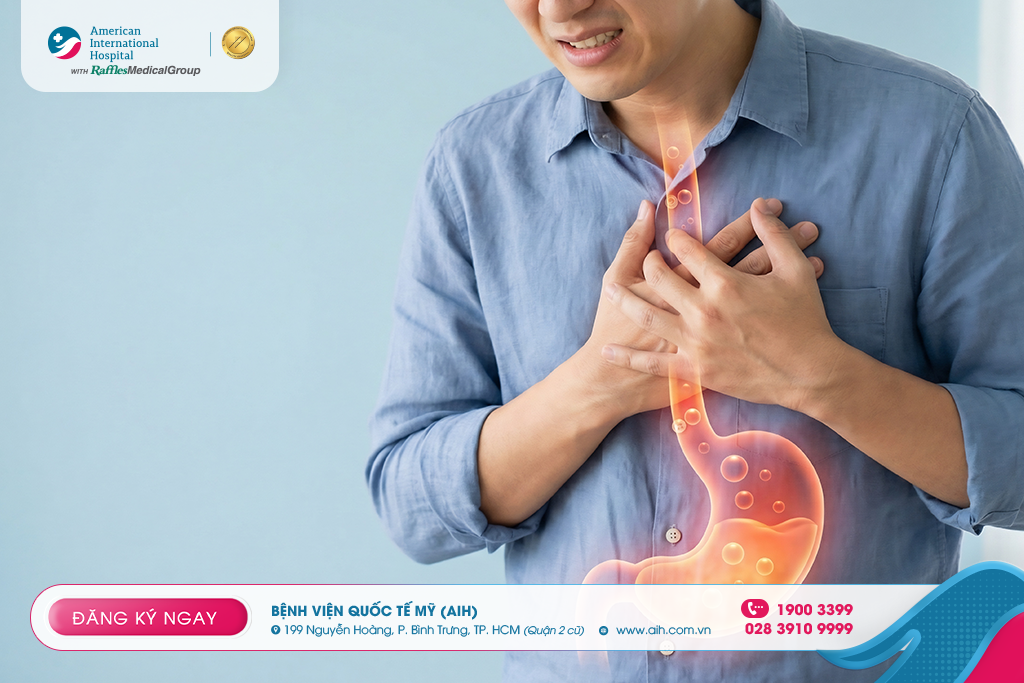
Normally, between the esophagus and the stomach, there is a valve whose function is to prevent fluids in the stomach from refluxing upward. When this valve functions poorly, acid and digestive fluids flow backward into the esophagus multiple times a day.
If this condition persists, the esophageal mucosa will become irritated and damaged, causing symptoms such as:
Retrosternal burning sensation
Acid regurgitation
Bitter taste in the mouth
Chest pain and tightness
Dysphagia in severe cases
Upon endoscopy, physicians may observe inflammation, erosion, or ulceration of the esophageal mucosa. This is a group of conditions that generally responds quite well to acid-suppressing medications combined with lifestyle and dietary modifications.
Gastroesophageal reflux without esophagitis
Not everyone with reflux has visible lesion upon endoscopy.
In many patients, acid still refluxes into the esophagus more frequently than normal, but not yet enough to cause inflammation or visible lesion detectable by endoscopy.
Therefore, despite a normal endoscopy result, the patient still presents with full symptoms of reflux disease, such as:
Retrosternal burning.
Acid regurgitation.
A burning sensation radiating up toward the neck.
Postprandial discomfort.
These cases are known as non-erosive reflux disease (NERD).
To make an accurate determination, doctors usually need to perform additional specialized tests to measure the amount of refluxed acid over a 24-hour period.
Esophageal hypersensitivity
This is a condition that is increasingly detected in people who have been treated for reflux but whose symptoms persist.
The difference is that the amount of acid refluxed in these individuals is not greater than in normal people. However, the esophagus has become overly sensitive.
You can picture the esophagus like our skin.
When the skin is healthy, a light touch will not cause pain. But if the skin is burned or scratched, even the slightest touch will make you feel a burning sensation.
The esophagus is the same.
Following multiple exposures to acid or alterations in the pain-sensing nervous system, the esophagus becomes more "sensitive" than usual. Consequently, even a tiny amount of acid, or even reflux episodes that are considered normal in healthy individuals, is enough to trigger a burning sensation or pain.
Because the cause no longer lies in the amount of acid, many people do not experience significant symptom improvement even after taking acid-suppressant medications correctly.
Functional Heartburn
This is the most difficult group of conditions to recognize.
Patients still feel a burning sensation behind the sternum that is identical to reflux disease. However, upon careful examination, doctors do not find:
Esophagitis
Abnormal acid reflux
A correlation between reflux episodes and symptoms
In other words, the burning sensation at this point is no longer caused by acid.
Scientists believe the cause is heavily linked to a disturbance in the nervous system's processing of pain signals. Prolonged tension, anxiety, insomnia, or stress can make the symptoms more pronounced.
In this group of patients, continuing to increase the dosage of acid-suppressing medication typically yields little benefit.
Why is it so easy to confuse them?
What makes these pathologies difficult to differentiate is that they all share nearly identical symptoms.
Patients may experience all of the following:
Retrosternal burning sensation
Acid regurgitation
Non-cardiac chest pain
Postprandial discomfort
Based on symptoms alone, even physicians find it extremely difficult to confirm which group a patient belongs to.
That is why some individuals respond very effectively to reflux medications, while others take them for months or even years with almost no change in their symptoms.
How to properly diagnose the condition?
Esophageal endoscopy is the initial step to help detect lesions such as inflammation, ulceration, or complications of reflux.
If the endoscopy is normal yet symptoms persist, the physician may order additional advanced tests to evaluate the amount of refluxed acid and determine whether the symptoms are truly related to reflux episodes.
Thanks to these techniques, physicians can differentiate between:
True gastroesophageal reflux disease.
Non-erosive reflux disease.
Esophageal hypersensitivity.
Functional heartburn.
Accurate diagnosis helps avoid unnecessary prolonged treatment and allows for the selection of an appropriate approach to each individual patient.
Is the treatment the same?
The answer is no.
If the cause is excessive acid reflux, the treatment goal is to reduce the amount of acid and limit the reflux episodes.
Conversely, if the cause is esophageal hypersensitivity or functional heartburn, simply increasing the dose of acid-suppressive medication usually does not solve the problem. In such cases, physicians may consider medications that regulate esophageal pain perception, combined with lifestyle modifications, stress reduction, and sleep quality improvement.
Therefore, identifying the correct cause from the outset will help patients achieve more effective treatment, save time, reduce costs, and avoid the unnecessary use of medication.
Conclusion
Not everyone experiencing retrosternal burning suffers from the exact same condition. For some, it is caused by excessive acid reflux; for others, the esophagus has become overly sensitive; and for still others, symptoms stem from a disorder in the nervous system's pain perception mechanisms.
If you have undergone appropriate reflux treatment for several weeks or months without any symptom improvement, do not arbitrarily increase the dosage or prolong the duration of medication use. A specialized medical examination and accurate identification of the root cause will help determine the appropriate treatment approach, prevent unnecessary medication use, and improve quality of life.
At the Department of Gastroenterology, American International Hospital, patients are examined by a team of experienced gastroenterologists, combined with the next-generation Olympus endoscopy system capable of early detection of reflux esophagitis lesions and many other gastrointestinal diseases. For cases with prolonged symptoms but normal endoscopy results, doctors will conduct a comprehensive evaluation to differentiate between gastroesophageal reflux disease, esophageal hypersensitivity, and functional heartburn, thereby formulating an appropriate treatment regimen.
If you frequently experience a retrosternal burning sensation, acid regurgitation, unexplained chest pain, or have been undergoing treatment for acid reflux for a long time without the symptoms improving as expected, patients should visit the Department of Gastroenterology at the American International Hospital (AIH) for an examination, accurate diagnosis of the cause, and the development of an appropriate treatment regimen from an early stage.
References
Swada A, Sifrim D, Fujiwara Y. Esophageal Reflux Hypersensitivity: A Comprehensive Review. Gut Liver. 2023;17(6):831-842. doi:10.5009/gnl220373. PMID: 36588526; PMCID: PMC10651372.
--------------------
![[FREE REGISTRATION] SPECIAL OPPORTUNITY TO CONSULT WITH AN INTERNATIONAL ONCOLOGY EXPERT AT AIH](https://aih.com.vn/storage/event-dr-yasuo-150x150.png)


Leave a comment