


























































Notification

THANK YOU FOR MAKING AN APPOINTMENT AT AIH.
Would you like to pre-register?
Please fill in the information below
Urgent
WOMEN ALSO HAVE A… “PROSTATE” - THE SURPRISING STORY BEHIND THIS MYSTERIOUS STRUCTURE IN WOMEN

When mentioning the prostate gland, most people automatically assume it is an organ found only in men. However, modern medicine has proven that women also possess a similar structure, although it is smaller and less well-known. This structure is called the Skene’s gland and is sometimes referred to in medical literature as the “female prostate.”
Only within the past 10 – 15 years, alongside advances in research on women’s health and female sexual function, has the role of the Skene’s gland gradually become clearer.
WHAT IS THE “FEMALE PROSTATE” – A MYSTERIOUS YET FASCINATING STRUCTURE?
When people hear “prostate gland,” they immediately think of men. Few realize that women also have a structure similar to the prostate, just much smaller and less recognized. Anatomically, this structure is known as the Skene’s gland. Some scientists even informally refer to it as the “female prostate.”
Below are interesting and surprising facts about this structure that science has uncovered over the past decade.
1. What is the Skene’s gland?
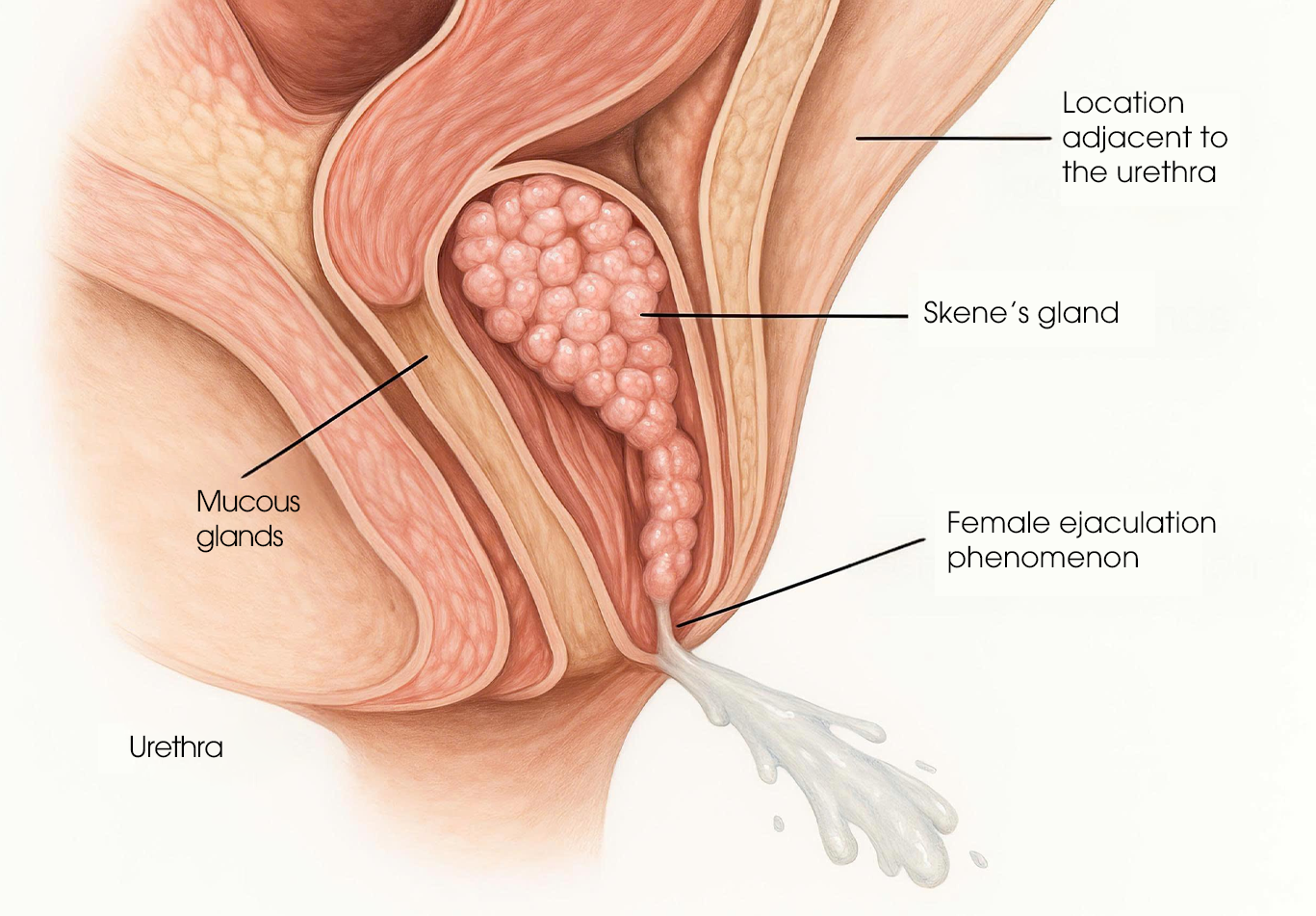
The Skene’s gland is located on the anterior wall of the vagina, close to the urethral opening (urinary opening). Because it lies somewhat deeper inside and is very small in size, many women are unaware that they have this structure.
An important point to understand:
The Skene’s gland secretes a fluid whose components are similar to those produced by the male prostate. More specifically, fluid from the male prostate contributes to semen, which is released during ejaculation.
Similarly, the Skene’s gland contains PSA (prostate-specific antigen) and PAP (prostatic acid phosphatase), substances commonly known as characteristic markers of the male prostate.
For this reason, scientists consider the Skene’s gland a “miniature version” of the female prostate.
2. The Role of the Skene’s Gland
According to studies conducted between 2010 and 2025, the Skene’s gland may play the following roles:
Supporting lubrication of the urethral and vaginal area.
In some cases, potentially influencing sexual pleasure in women.
Contributing to the phenomenon of “female ejaculation.” Put playfully: a woman’s “wow” moment may also bear the mark of the Skene’s gland.
Although it is not yet fully understood, current findings suggest that the Skene’s gland is not as “useless” as previously thought.
3. Why Is It Called the “Female Prostate”?
This structure shares many similarities with the male prostate gland: The same embryological origin, the same type of glandular cells, and the production of PSA. Because of these similarities, both sexes can develop certain comparable conditions, although this is very rare.
What seems like a new perspective is, in fact, a reaffirmation of something fundamental: males and females are not entirely different. Many body structures originate from the same initial “blueprint” during embryonic development. In the embryonic stage, males and females are more than 90% alike.
From the same “design,” however, development later diverges:
In males, it develops into a fully formed prostate gland.
In females, it remains as a “minimalist” version – small and subtle, true to its own nature.
4. Rare Conditions… Yet Scientifically Fascinating
Due to its small size, the Skene’s gland rarely causes disease. However, medical literature from 2010–2025 has documented several noteworthy cases:
Inflammation or obstruction of the Skene’s gland
Like the salivary or sweat glands, the Skene’s gland can become blocked, leading to inflammation, cyst formation, or even an abscess. This condition may cause pain, dysuria, or a palpable mass near the urethra on the anterior vaginal wall.
Skene’s gland cyst
Some women, either incidentally or due to symptoms, are found by physicians to have a small lump near the urinary opening. In most cases, this is a benign cyst that can be treated relatively easily.

Skene’s gland cancer: possible, but extremely rare
Over the past 15 years, global medical literature has recorded only about 20–25 cases.
More recently (2020–2024), a few additional rare cases have been reported, helping physicians better understand this organ. Interesting findings from these rare cases include:
The cancer may cause elevated PSA levels in women, similar to prostate cancer screening in men. In other words, women with Skene’s gland cancer may experience increased PSA levels, just like men. The disease can easily be mistaken for urethral or bladder cancer because these organs are located very close to one another. This further demonstrates that Skene’s gland truly resembles the prostate to a degree that can make differentiation challenging. However, it is important to emphasize that Skene’s gland cancer is so rare that most urologists may never encounter a single case in their entire careers.
What Does This Mean for Women?
That said, women do not need to worry about Skene’s gland cancer, as it is extremely rare. However, having knowledge and awareness of this organ helps women better understand how sophisticated and remarkable their bodies truly are. There is no need to panic upon seeing the term “PSA” appear in women. Instead, it is reassuring to recognize that women, too, have biological features that are just as intriguing and complex as those in men.
“In every woman, there is a ‘mysterious core’ that carries echoes of the male prostate.” It is important to recognize signs of inflammation or cyst formation if they appear, and to be able to explain certain physiological characteristics that were once difficult to understand. All of this reminds us that the female body possesses layers of refinement and fascination that medicine is still continuing to explore.
5. Why Has Science Gained a Clearer Understanding of the Skene’s Gland in Recent Years?
One notable factor is that women today are increasingly attentive to their health, especially regarding urinary function, urinary disorders, and particularly sexual dysfunction. In the past, many women, especially in Asian cultures, tended to accept certain symptoms as “normal,” especially after childbirth or with aging. Such issues were often regarded as inevitable and simply part of being a woman. Today, however, women are more proactive in seeking medical consultation and asking “why.” With the help of new diagnostic tools and techniques, such as advanced imaging, molecular biology, and research into sexual function and hormones, scientists have begun answering questions that were neglected for decades.
The Skene’s gland is a prime example of a small anatomical structure that offers meaningful insight into the female body.
In Summary:
The Skene’s gland can be considered the “female version of the prostate”, small, yet with a defined role. Although it may be associated with certain rare conditions, the vast majority of women will never experience problems related to this gland. Most importantly, knowledge empowers women to respect and listen to their bodies more attentively. The diversity and subtle complexity of the female body are always astonishing, and the Skene’s gland is part of that wonder.

IS FEMALE SEXUAL DYSFUNCTION RELATED TO THE SKENE’S GLANDS?
Answer: POSSIBLY.
1. Skene’s gland inflammation (Skenitis): Pain during intercourse
Causes pain in the urethral and vaginal area during sexual intercourse
Burning, stinging, or prickling sensations during sexual stimulation
May be mistaken for persistent urinary tract infection
This is an often-overlooked cause of dyspareunia (painful intercourse) in women.
Learn more about a typical Skene’s gland cyst treatment case at American International Hospital (AIH) here.
2. Skene’s gland cyst or abscess: Reduced urethral pleasure
This point is very subtle but extremely important:
Some women experience orgasm linked to urethral stimulation or the so-called female prostate.
If the duct becomes obstructed, secretion may decrease, which in turn may reduce the sensation of “Skene-type” climax.
3. Androgen deficiency or menopause: Decreased Skene’s gland activity
What we know is that the Skene’s glands contain androgen receptors. Therefore, when testosterone levels in women are low (such as during menopause, after oophorectomy, or in certain endocrine disorders), secretion may decrease. This can lead to reduced urethral fullness sensation, potentially affecting libido and diminishing sexual pleasure or orgasm.
Not all women perceive this component clearly, but among those who are particularly responsive to urethral stimulation, the difference can be noticeable.
4. Orgasmic disorders related to the Skene’s glands
Some women describe experiencing two types of orgasm:
“Clitoral” orgasm
“Urethral” orgasm (associated with the Skene’s glands)
If the Skene’s glands are dysfunctional, it is understandable that the second type may be significantly affected.

In summary: Although small, the Skene’s glands play a fascinating role in female sexual function. In other words, the Skene’s glands may be small, but when something goes wrong, the impact is not small at all.
Dysfunction in this highly sensitive area can cause painful intercourse, decreased secretion, reduced orgasm intensity, and diminished sexual desire, particularly in women with heightened Skene-related sensitivity.
--------------------
Search
Latest News



Our Doctor
Leave a comment